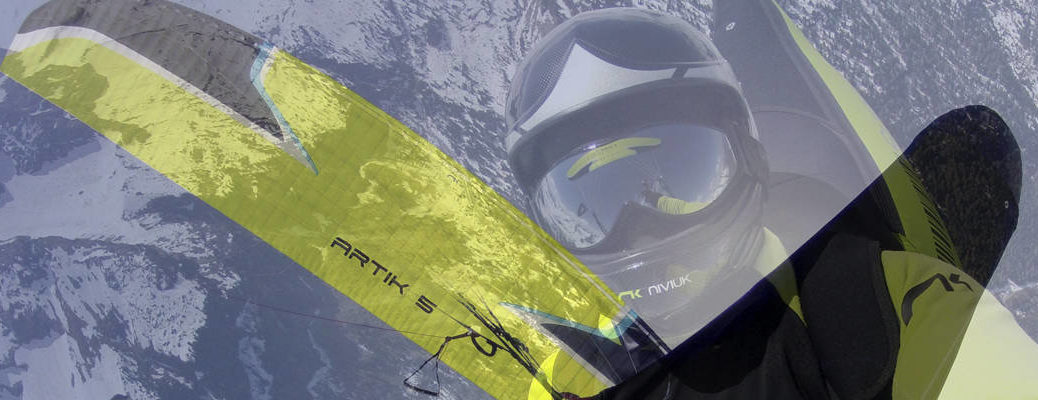
At the end of this flying season Italian pilot Kurt Eder has won the PG Sport (EN C) category of the World XContest 2019 in the with a total of 2521.52 points. But if this were not enough, his six best flights with the Artik 5 (EN C) have also earned him second place in the PG Serial (EN D) category. https://www.paragliding.eu/niviuk-artik-5/
An achievement reached thanks to spectacular flights such as the one he made in July from Antholz (Italy) where he managed to complete a FAI triangle of more than 270km.
Congratulations Kurt! You can check the official World XContest 2019 rankings at the following links:
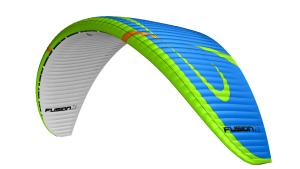
Der Flow Fusion vereint 2-Liner-Feeling mit einer EN C-Zertifizierung und ist der erste zertifizierte Hybrid-2-3-Liner-Gleitschirm. Fühlen Sie sich verbunden wie eine 2-Leiner-Rennmaschine, mit einer Lenkung für die hintere Steigleitung auf handgefertigten Bedienungsknöpfen, aber behalten Sie die Sicherheit und komfortable Arbeitsbelastung eines EN C-Segelflugzeugs bei. Eine optimierte Linienkonfiguration und einzigartige Riser ermöglichen ein dreizeiliges Layout in der Mitte der Spannweite und ein zweizeiliges Layout an den Spitzen. Die daraus resultierende Reduzierung des Luftwiderstands erhöht die Leistung spürbar.
Sorgfältige Aufmerksamkeit in der Entwurfsphase hat zu einer außergewöhnlichen thermischen Handhabung geführt, die die Zusammensetzung von 2-Liner in die EN C-Klasse gebracht hat. Die Spannung über die Spannweite erzeugt einen kompakter wirkenden Gleiter und hält die Energie in der Kurve aufrecht, die es der Fusion ermöglicht, durch den Himmel zu schnitzen. Surfen Sie mühelos zur Cloud-Basis und rennen Sie dann effizient auf der Bar davon.
Ein pechstabiles Tragflächenprofil, das weniger anfällig für Zusammenbrüche und Schwingungen ist, ermöglicht es dem Piloten, sich auf die Bedingungen und Entscheidungsfindung zu konzentrieren, ohne das Segelflugzeug unter Kontrolle zu haben. Das bescheidene Seitenverhältnis und die Anzahl der Zellen bedeuten eine angenehme Arbeitsbelastung, wie sie für ein EN C-Segelflugzeug erwartet wird. Das Haifischnasenprofil, die 3D-Formgebung und die detaillierte Innenstruktur ergeben zusammen einen modernen Flügel der Sportklasse.
Bei hoher Geschwindigkeit ermöglichen die Fusion-Tragegurte dem Piloten ein geschicktes Fliegen des Segelflugzeugs durch Ändern des Anstellwinkels, ohne das Profil zu verzerren. Dank der zwei Liner-Riser kann der Fusion die Turbulenzen effizienter überwinden, sodass der Pilot über den gesamten Geschwindigkeitsbereich eine bessere Leistung erzielen kann.
„Ich wollte die Leistung unserer äußerst erfolgreichen zweizeiligen Projekte XCRacer und Spectra in die Klasse EN C bringen. Diese Fusion hat ein zugängliches Paket hervorgebracht, das ein Traum zum Fliegen ist und eines der angenehmsten Segelflugzeuge, die ich je geflogen bin. ‘ Felipe Rezende (Flow Designer).
Flow is the new Australian brand. The XC racer is their EN-D 2 liner glider, and they released a beautiful new CCC, the Spectra.
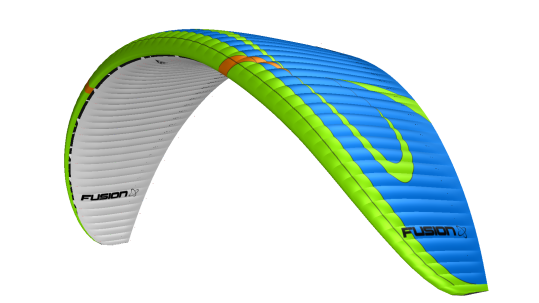
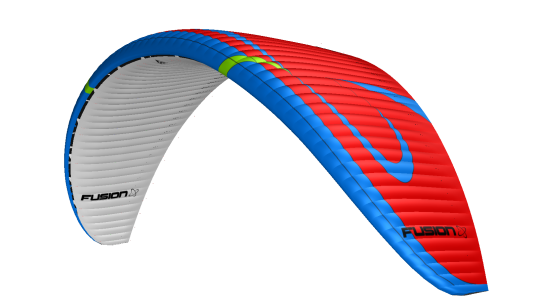
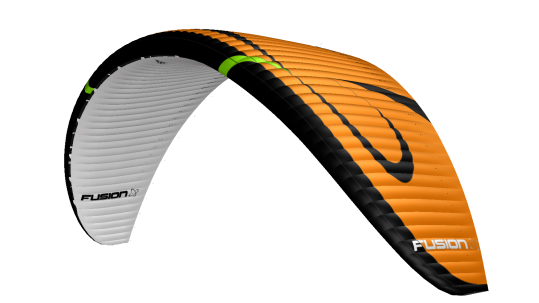
The Fusion is their new EN-C glider.
My friend, lend me his M size ( 80-103 ) to test fly it. At first glance, I opened the package and saw a minimalistic line distribution, with a sliding B riser, and C control steering. That amount of very few lines means ‘performance’….Let’s see…
I ballasted up to 99 all up on the M, with my X-rated 6 harness.
Launching the Fusion with its 6.3 aspect ratio is a piece of cake. Steady pull, and no surge forward, after a small brake input.
Launching is immediate. I had already shortened the brake lines by 5 cm. That way only 7 cm of the gap remained when the brakes are released.
Full bar is achieved without any tension on the brakes.
The Fusion was flown next to an Advance X-Alps 2 M, Mantra7 MS, Delta3 ML, Q-light S, in order to understand how it performs in the same conditions.
The brakes have light pressure on the first 10 cm, then slightly harder when pulled beyond 35 cm. The agility is on the average side but ok. In mild conditions, the Fusion can be turned quite tight inside the thermals. The precision of the brakes are good in mellow conditions and slightly less in turbulent cores.
In stronger and turbulent air, I would have wished for more precise control, and slightly better pilot authority on the brakes, in order to put it exactly where I wanted. But as you know, I’m a bit sensitive toward brake authority when test-flying a new glider.
My friend ‘Amer’ who is a Rush 5 pilot, flew the Fusion and commented that it was one of the best handling gliders regarding sensitivity.
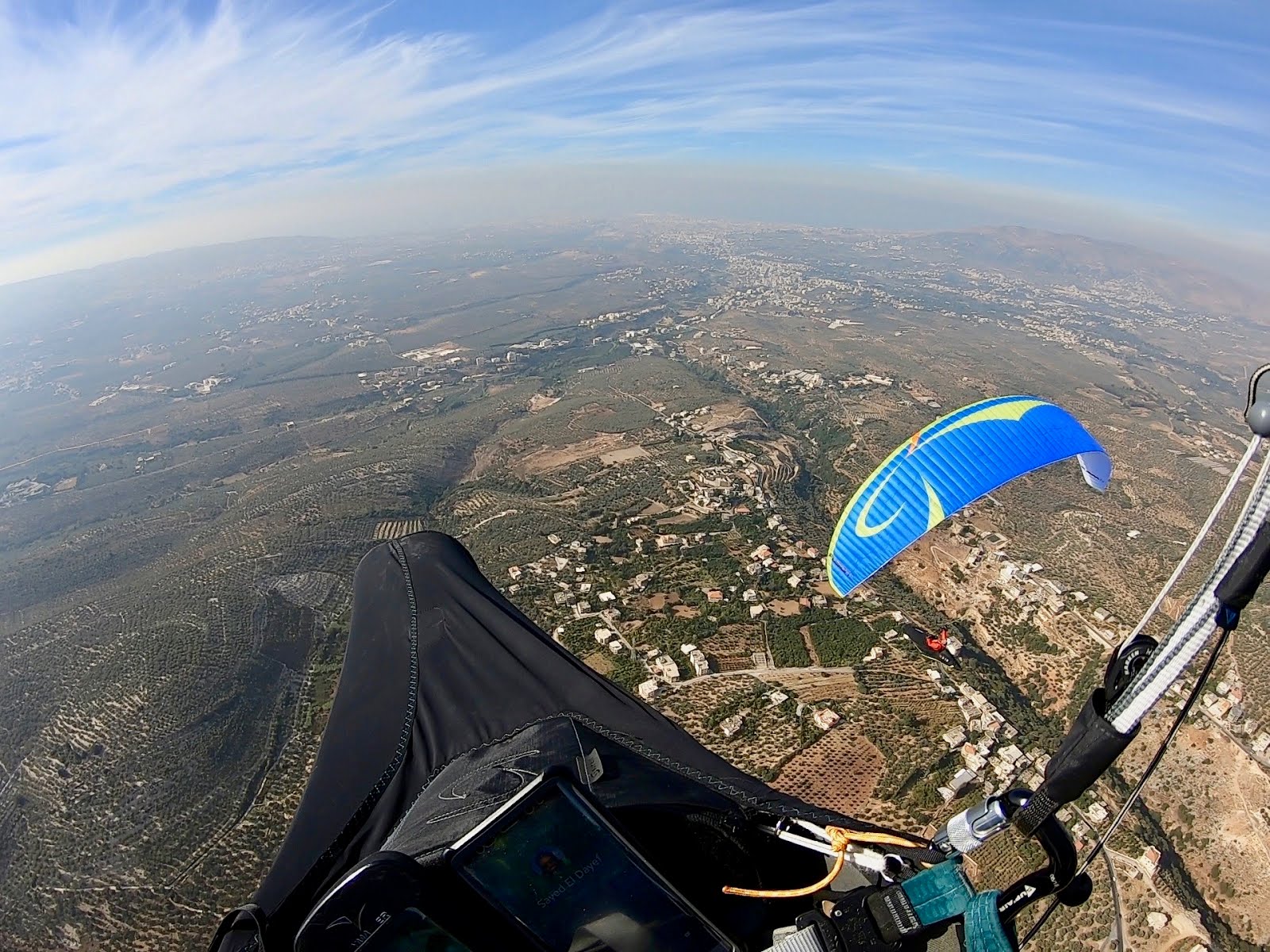
And my other friend ‘Sayed’ who is a Cayenne 5 M pilot, commented that it was mellow to his taste and was missing some little spices.
So different opinions for different tastes…regarding the brake authority.
I found it slightly less agile than the Delta 3 MS, and the Q-Light S, but turns flatter! and has this new ‘search, grab and hold’ feature to never let go of a thermal!
I was also very surprised about the mellow feel under this 6.3 aspect ratio glider! It’s really a very dampened C glider. Probably one of the most pitch stable and overall stable glider in the C category! In average conditions, and high B pilot would find it very easy to fly, as my friends ‘Amer’ and ‘Sayed’ both commented, that its a faster and more performant ‘Rush 5’ with practically the same comfort under it in moderate conditions…
Of course, in stronger air, it needs an active pilot control as the authority on the brakes diminish a little.
But IMHO, any good high B pilot will be welcomed under this C machine.
Now the interesting part is the performance in climb and glide. Flying next to those gliders mentioned above, I can confirm a good climb rate for the Fusion M. To be even more precise, i think in smooth weak conditions it floats nicely. Not the best one in its category but a very good one. The strong point in the Fusion climb rate is when there’s an influence of little wind or valley breeze. Even in weak thermals, the Fusion surfs the air and grab that thermal. The more valley breeze, the more efficient the Fusion is for a C glider. When the climb is well built, the Fusion climbs very nicely. There’s not any pitch movement in moderate conditions, to the point of wondering how the hell it is searching for that lift and climbing!
After trying some good glides with reference gliders in the C and D category, I was very impressed by the glide angle of the Fusion!
Not only the Fusion is trimmed fast but it surfs the air without any pitch behavior to deteriorate that glide. On the contrary, it searches smoothly and calmly with a positive vario the lift in the airmass. To describe it best, it looks like sitting comfortably in a (TGV)!
Flow has created its best glider so far concerning glide efficiency. The Fusion scores the best glide angle in the C category at trim speed and could match some recent D gliders, except the M7, and close to the best C’s at full bar!
I’m waiting for the S size, which could be hopefully more agile. Let’s wait and see…
The top speed is around 12-13 km/h over trim, with pulleys overlapping.
The C controls have a slightly moderate to hard pressure, but efficient to keep the glider in control in overall conditions.
ears are stable, slightly efficient and reopen with a little pilot input.
Conclusion:
I don’t know how they did it…But I think Flow has forged the Fusion with aboriginal magic!
An excellent glide angle for that C glider, and a high level of comfort.
Flow Fusion S (70-92)
After flying the M size, I flew the S size from 88 till 92 to find that the optimum weight for the S size was around the top weight. At 90 the Fusion still climbs well, even in weak conditions.
At 92 it surfs well the air and the glide headwind in amazing for the C class! The authority on the rakes for the S size at top weight is better than the M size at 100, as I found it slightly more agile. To place it accurately in terms of feel, the brake travel and the precision of the turn are slightly less than a Sector, Cayenne 5, or Queen 2 for example, but still very satisfying. The Fusion transmits the glider movements by the risers, not by the brakes.
In turbulent and jumpy conditions, you need a long pull to control it overhead, but the overall movements are soft. The leading edge has a strong tendency to avoid frontals. When trying to shot forward the leading edge intentionally, the Fusion leading-edge resist to collapse, and frontals are well delayed. The brake travel is long before the stall, with brakes under the seat, the Fusion also resist well before stalling.
Big ears are stable on the S size and reopen with pilot input.
Conclusion: Flying it at 90-92, I found it well balanced without being flown heavy. It seems that you can float nicely even flying it on top. Like its bigger sister, the S size is not trimmed differently. It is a true balanced S size C glider, with lots of performance, and especially good passive safety for the category, and gives a relaxed feel under it. It is more agile than the M. As I described the high level of comfort under it, I have to point out that the Fusion S is an agile glider, with a medium brake-travel.
Zum Verkauf steht die neue Internationale Premium – Doamin www.paragliding.shop Der Link zur AUKTION: https://www.ebay.de/itm/333350844219 —————————————————————————————————–
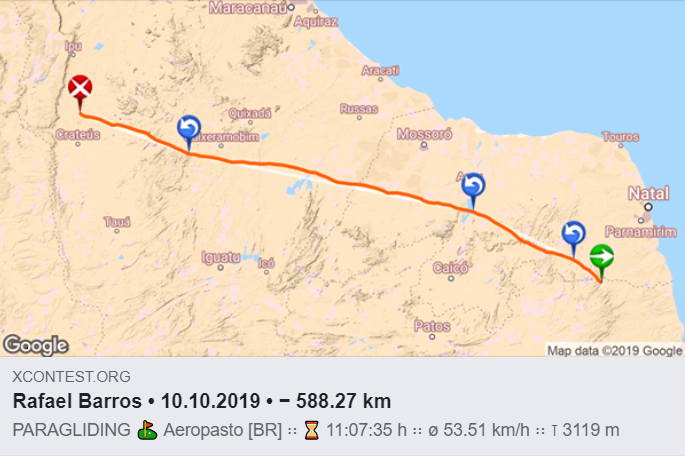
Rafael Barros fliegt am 10. Oktober 2019 den Weltrekord mit 588,27 km von Aeoropasto Brasielien. Seine Durchschnittsgeschwindigkeit ist sagenhafte 53,51 km/h. Auch natürlich ein starker Verdienst des Niviuk Peak EVOX 🙂 “Congratulation for a flight with 11 hour and 7 minutes! “
NOVA EHRT PILOTS OF THE YEAR 2019 Leistung und Engagement
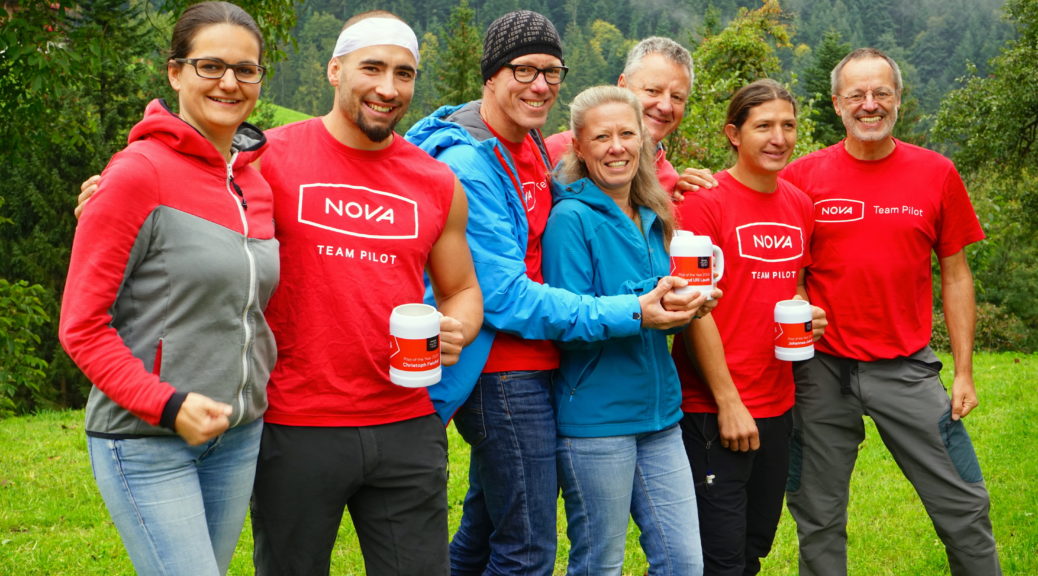
Im Rahmen des jährlich stattfindenden Pilots Team Meetings zeichnete NOVA mehrere Piloten als „Pilots Of The Year“ aus: Victor „Pope“ Salinas (Chile), Chris Feichtl (AUT), Stefan und Uli Lauth, Hermann Klein sowie Johannes Jakobi (alle GER). NOVA verlieh die Auszeichnungen bereits zum 13. Mal und bewertet dabei nicht nur sportliche Erfolge, sondern auch die Begeisterung sowie das Engagement für den Gleitschirmsport bzw. die Marke NOVA. Die sechs Gewinner erhielten als Dankeschön einen Gutschein über 400 Euro auf den nächsten Schirm und einen personalisierten Sieger-Maßkrug als Erinnerung.
—————————————————————————————————————– Werbung:
DOMAINVERKAUF Auktion: www.Paragliding.Shop ab € 350,00.- Versteigerungsende 12.10.2019
Zum Verkauf steht die neue Internationale Premium – Doamin www.paragliding.shop Der Link zur AUKTION: https://www.ebay.de/itm/333350844219 —————————————————————————————————————–
Am eindeutigsten war die Wahl von Uli und Stefan Lauth. Die beiden flogen mit einem BION 2 nicht nur einen neuen Weltrekord (232 km FAI-Dreieck), sie gewannen auch die Tandemwertung des DHV-XC mit dem größten Vorsprung aller Zeiten und belegten weltweit im XContest Rang 3 in der Tandemwertung.
Die Wahl von Chris Feichtl aus der Steiermark war ebenso klar. Obwohl er erst seit drei Jahren fliegt, konnte er sich in der Weltklasse der Streckenflieger etablieren. Mit seinem MENTOR 6 belegte der Messerschmied in der weltweiten Standardklasse-Wertung Platz 3. Außerdem bringt er von seinen Abenteuern regelmäßig großartige Fotos mit nach Hause.
Hermann Klein gehört zu jenen, die seit Jahren immer wieder fast als Pilot Of The Year ausgezeichnet wurden. Endlich erhielt er den Award. Hermann ist nicht nur ein exzellenter Strecken- und Wettkampfpilot, sondern macht sich um die Organisation der NOVA XC Team Challenge verdient (auch wenn sie 2019 wegen des Wetters ausfiel).
Nach dem Motto „stille Wasser sind tief“, ist Johannes Jakobi kein Freund großer Worte. Er lässt lieber Taten sprechen – aber dafür richtig: Der Schwabe belegte mit seinen MENTORen 5 und 6 im Deutschland-Pokal sowie in der Flachland-Wertung des DHV-XC jeweils Platz 6 – umgeben von EN C-, EN D- und CCC-Schirmen.
Der Chilene Victor „Pope“ Salinas verdiente sich seine Ehrung mit einer Vielzahl großartiger Flüge sowie seinem Engagement für die Fliegerszene vor Ort. Ihm gelang der Gesamtsieg in der chilenischen Streckenflugliga – vor allen Hochleisterpiloten – und er erzielte die meisten Punkte von allen Standardklasse-Piloten in Nord-, Mittel- und Südamerika.
NOVA Team Captain Till Gottbrath sagt: „Die Saison 2018/19 war ein gutes Jahr für das NOVA Pilots Team und erneut fiel uns die Auswahl der Pilots Of The Year schwer. Es gab eine ganze Reihe weiterer Piloten, die den Titel ebenso verdient gehabt hätten.”
Leichter, mehr Leistung und mehr Fun als je zuvor!
Der neue Geo6 überzeugt mit dem höchsten Leistungsgewinn und zugleich der größten Gewichtseinsparung, die es in der Geo-Geschichte bislang gab. Moderne Konstruktionstechniken und ein cleverer Einsatz der Materialien haben dazu beigetragen 350 Gramm Gewicht im Vergleich zu seinem Vorgänger einzusparen. Moderne Konstruktionstechniken und ein cleverer Einsatz der Materialien haben dazu beigetragen 350 Gramm Gewicht im Vergleich zu seinem Vorgänger einzusparen.
Das ist für Piloten, die sich eine sehr zugängliche XC Leitung gepaart mit geringem Gewicht und Packvolumen wünschen, der ideale Reise- und Abenteuerschirm in der Intermediate Klasse. In Kombination mit dem SOLOS Gurtzeug bringt es als komfortable und leichtgewichtige XC Ausrüstung weniger als 7 kg auf die Waage!
NEUE TECHNOLOGIE
Wir haben das SharkNose Profil verbessert, indem wir die Zellöffnungen modifiziert haben um den Innendruck bei allen Anstellwinkeln zu verbessern, und haben G-Strings eingesetzt wie sie auch der Rush 5 hat. Diese Bänder (G-Strings) tragen dazu bei, besonders im beschleunigten Flug eine klare Öffnungsform aufrechtzuhalten und unterstützen das Wieder-Füllverhalten – Klapper öffnen sich schneller und mit weniger Höhenverlust. Die Anströmkante zeigt auch ein doppeltes 3D Shaping und profitiert von Modifikationen der Segelspannung und der Bahnenform um den Luftfluss in diesem aerodynamisch kritischen Bereich zu klären.
NEUE INNENSTRUKTUR
Dank der spannweitig verlaufenden Bänder und modifizierten querlaufenden Öffnungen in den Rippen, die Kohäsion, Spannung und Luftzirkulation verbessert haben, hat sich die Gleitleistung des Geo6 in aktiver Luft und im beschleunigten Flug erheblich verbessert. Zudem werden Turbulenzen besser absorbiert und das Segel deformiert sich weniger.
MATERIALIEN
Die Innenstruktur des Geo6 ist technisch so gestaltet, dass der Flügel langlebiger ist. Die Oberfläche ist aus einem Mix aus Dominico 20D und Porcher 27 Classic gefertigt, und das Untersegel nur aus Porcher 27 Classic. Der Geo6 ist um 1,55 Kilogramm leichter als der Buzz Z6 und um 350 Gramm leichter als sein Vorgänger – ohne Einbußen in den Bereichen Belastbarkeit und Lebensdauer!
START & FLUG
Vor allem ist der Geo6 einfach und angenehm zu fliegen. Dank eines leichteren Segels, besserer Effizienz, und einem kohäsiveren, agileren Gefühl sind das Starten und Bodenhandling nie einfacher gewesen. In der Luft ist das Handling intuitiv, super agil und macht einfach Spaß. Die Bremseinwirkung ist progressiv – mit einem präzisen Gefühl. In der Thermik und in aktiver Luft kreieren die strukturellen Verbesserungen einen komfortablen und dennoch aussagekräftigen Flügel.
Durch sein geringes Gewicht und Packvolumen ist der Geo6 der ideale Schirm für Piloten, die sich auf Reisen oder Hike & Fly Missionen befinden und generell etwa 30-50 Stunden im Jahr fliegen und für erfahrene Piloten, die sich einen Flügel mit einem hohen Maß an passiver Sicherheit wünschen, die ideale Wahl.
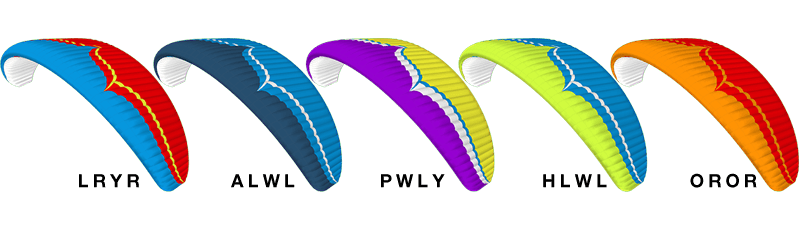
Farbwahl
Bestellinfo
Lead time is currently unavailable. Contact your dealer for more information or to place an order.
Lieferumfang
OZONE offers a range of backpack choices when you order your wing. To change the type of backpack that will come with your wing, please speak with your OZONE Dealer.
Dein OZONE Schirm wird standardmäßig mit dem folgenden Zubehör ausgeliefert::
You may choose to add something to your order, such as: Saucisse Bag (video) (concertina packing bag), Easy Bag (quick stuff sack), or OZONE Clothing and Accessories.
Ozone encourages you to customize your own personal colour combination for your wing. Customization generally incurs a small fee. Once you’ve decided you can share your design with your friends, or if you are ready to order, send it to your local Ozone dealer to check if there is a charge and place the final order.
Please note that because the glider will be built specifically for you in the Ozone factory, payment must be received before production can begin.
FABRIC COLOURS AND UV RESISTANCE
Please be aware that the colour you see on your screen may not accurately represent the actual fabric colour. Given the wide varience in monitor calibration and the fabric appearance in different light and colour combinations, it is impossible to perfectly represent fabric colour on screen. If you have any doubts about the colours, look at photos of various wings on our website to see them in different light and colour combinations or contact your local dealer to see the fabric in person.
All of the fabric that we use undergoes extensive testing in prototype colour phase to ensure colourfastness, mechanical stability, porosity, and general longevity before we put it into production. Once our fabric is in production, every meter of it is rigorously inspected upon arrival in our factory, and fabric which does not pass our stringent quality control standards is returned to the manufacturer. We are frequently asked, „Which colours last the longest, or have the best UV resistance?“ All of the colours that we stock score between 4 and 5 on a scale of 1-5, with 5 being the highest possible rating for longevity.
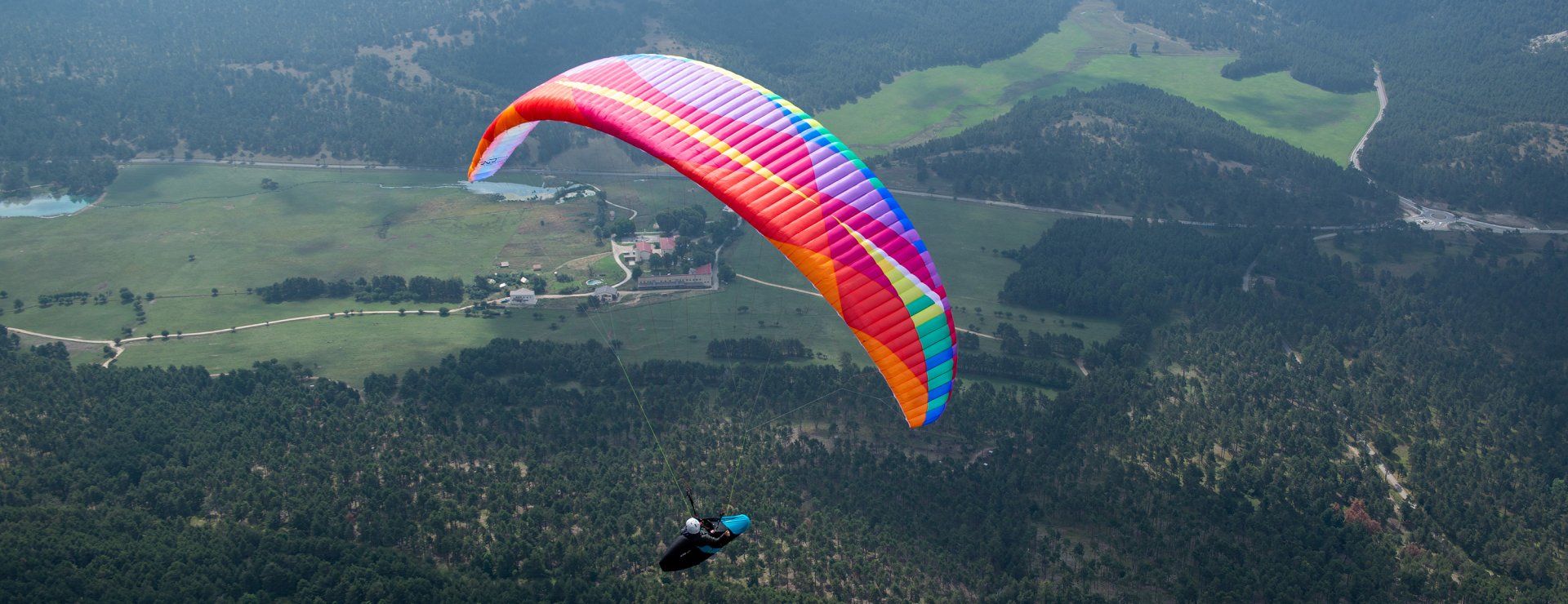
The new GEO 6 is the lightweight version of the Buzz Z6. It delivers high amounts of passive safety in a lightweight adventure wing with True Performance throughout the entire speed range.
Modern construction techniques and a clever use of materials have saved 350 grams of weight compared to its predecessor, and all of the performance gains made in the Z6 project have been directly passed on.
20% Less Line Drag Refined Shark Nose Profile G-String Leading Edge Double 3D Shaping
Soar to new levels of performance: embrace your passion, heal your soul!
50M iterations fluid/structural analysis
B/C steering system
Double skin leading edge
Strong shark nose
Größe
m²
20
22
23
25
27
XS
S
M
ML
L
Technische Daten
XS
S
M
ML
L
Linearer Skalierungsfaktor
0.93
0.97
1
1.04
1.08
Projizierte Fläche (m²)
16.9
18.1
19.4
20.8
22.6
Ausgelegte Fläche (m²)
20
21.5
23
24.6
26.8
Gewicht (kg)
4.3
4.6
4.9
5.2
5.7
Gesamtleinenlänge (m)
218
234
250
268
292
Höhe (m)
7
7.2
7.5
7.7
8.1
Anzahl der Leinenebenen (A/B/C)
3/3/4
Zellen
74
Ausgelegte Streckung
6.4
Projizierte Streckung
4.8
Flächentiefe (m)
2.2
2.3
2.3
2.4
2.5
Ausgelegte spannweite (m)
11.4
11.8
12.2
12.7
13.2
Projizierte Spannweite (m)
9
9.4
9.7
10
10.5
Trim Geschwindigkeit (km/h)
39
Höchstgeschwindigkeit (km/h)
60
Minimales Sinken (m/s)
1
Bestes Gleiten
11
Abfluggewicht (kg)
56-75
65-85
75-95
85-107
98-122
Zertifizierung
EN/LTF-C
Beschreibung
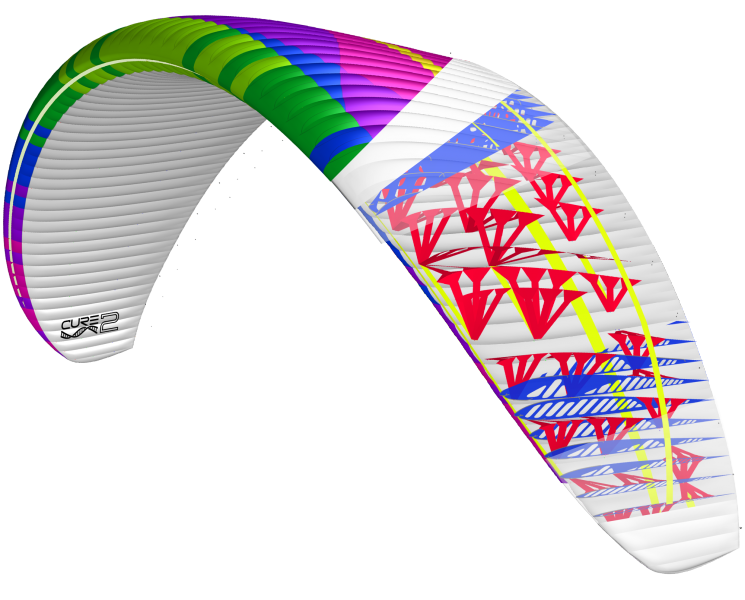
Für viele Piloten ist das Fliegen der beste Weg, der Hektik des Alltags zu entfliehen und der Natur näher zu kommen. Fliegen ist wie eine Art Meditation, um die Seele zu heilen. Deshalb haben wir den CURE 2 vollständig neu konzipiert, um die Performance zu steigern, ohne aber den Stress für Piloten zu erhöhen. Er hat eine brandneue und optimierte Innenstruktur und ein Profil das der Diva sehr ähnlich ist. Wir haben die Zellenzahl auf 74 erhöht, die projizierte Streckung beibehalten, aber die Krümmung der Kappe verkleinert, was bedeutet, dass die ausgelegte Streckung auf 6,4 verringert wurde. Der CURE 2 hat eine beeindruckende Höchstgeschwindigkeit von knapp 60 km/h, dennoch sind asymmetrische Klapper auch bei Top Speed hervorragend beherrschbar. Der CURE 2 wurde für schnelles XC Fliegen entwickelt und verfügt über ein neues und effizientes B/C-Steuerungssystem. Wir haben das Gewicht durch die Verwendung von hochwertigem Skytex 27/32 so gering wie möglich gehalten, wobei an der Eintrittskante das stärkere Skytex 38 für Langlebigkeit sorgt. Wenn Du mit dem CURE 2 fliegst, wirst Du ein neues Leistungsniveau erreichen.
Gleitschirme, die sprechen, sind sicherer. Sichere Gleitschirme machen den Piloten besser. Bessere Piloten fliegen weiter. Weiter fliegende Piloten sind glücklichere Piloten. Eyes Wide-Open Sicherheit bringt glücklichere Piloten hervor.
Ziel
Der CURE 2 ist für XC-Piloten gemacht, die Top Performance bei möglichst geringem Stresslevel suchen. Er gleitet äußerst effizient und nickstabil, hat eine hervorragende Stabilität in Turbulenzen und penetriert ausgezeichnet gegen den Wind. Seine hohe Zellenzahl und sein moderates Streckungsverhältnis gewährleisten eine hervorragende Leistung in dieser Klasse.
Notizen von Bruce
Wir bei BGD glauben an Progressive Stabilität. Mit unserem neuen Simulationsprogramm haben wir die Kappenspannung des CURE 2 so abstimmen können, dass eine perfekte Symbiose, aus struktureller Stabilität und den Kappenrückmeldungen an den Piloten, gelungen ist. Diese wichtigen Rückmeldungen der Kappe erlauben dem Piloten, auch bei schwierigen Bedingungen das Optimale aus dem Schirm heraus zu holen. Wir haben uns für die Verwendung von Kunststoffstäbchen über das gesamte Profil im mittleren Bereich des Flügels entschieden, um ihm die benötigte strukturelle Stabilität mitzugeben. Im Stabilobereich setzten wir die Kunststoffverstärkungen jedoch nur an der Eintrittskante ein. Dies reduziert die Verhängertendenz.
Disclaimer: It seems that I’m also BGD villain… 😉 I couldn’t get a hold of one as our dealer received again, (a note) No Cure 2 for Ziad! Cooldown guys !! 🙂 It’s the 21st century! And my last 2 BGD’s were purchased from abroad! … Gliders sent only to a “controlled” environment is an underestimation of the good pilots out there in the world, especially with the presence of a large social media network. I really regret BGD approach! I wouldn’t want the dealer to have any problems, so I waited until the demo was finally sold to a friend (Northern Eagles Club) flying in the north part of Lebanon. I visited him, and he was so kind as to lend me his new toy. I really hope that BGD will have more faith in the future!
BGD CURE 2
BGD Cure 2 M (75-95) (The edge)
BGD is a new company, created by the world champion, Bruce Goldsmith, that works with beautiful designs, cheerful colors, and with passionate young people working as a team. The Cure 2 M launches easily in nil wind without any hardpoint. If the pull is heavy, the Cure 2 surges forward rapidly but can be swiftly stopped by the brakes. In a strong breeze, the pilot must anticipate and stop the surge. A good C pilot won’t have any problem.
The BGD Cure 2 in size M (75-95) feels slightly big to fly it at mid-weight but quite manageable in weak conditions. In strong air, I found it best at 94, 95 all up. The trim speed is fast for the C category. A bit faster by one km than the Q-light S, the Fusion S, and 2 km/h over the Delta 3, Alpina 3. Flying with an X-rated 6 harness, the Cure 2 has a nice feel in the air! Like the Cure 1, the Cure 2 is an agile glider, with slightly longer brake inputs than the Cure 1.
BGD CURE 2 The brake travel is quite moderate and smooth, not short and not too long. After 10 cm of slack, 30-35 cm is needed to steer the glider in any thermal. The Cure 2 reacts smoothly, and accurately, to the pilot’s controls. It has a linear response throughout the brake range. It feels similar to the Mantra 7 in terms of brake feel, and time response, with a slightly more agile turn.
In thermals, the Cure 2 can be steered tightly into the core. The turning radius is clean and the Cure 2 stays on its path during the climb. It feels like sniffing the thermal and it gave me a nice feel while coring. It doesn’t get out of the turn inside a thermal, and while pulling more or less brake, the Cure 2 reacts well, to position it inside the lift.
In weak conditions, the Cure 2 seems to cope well with the best C’s of the moment despite its high trim speed. (You can see my C companion updated for the Cure 2 if you need to see the smaller details). A little adaptation is needed to keep the Cure 2 from diving into a turn in weak conditions. A little brake pull is needed and the Cure 2 will climb effortlessly. I can confirm that the Cure 2 floats well.
BGD CURE 2
The information is sent smoothly by the risers, not the brakes. The Cure 2 has a tamer feel is weak conditions, much like the M7 is that matter. The pilot must pay attention to the glider movements in order to feel those small 0.2 m/s lifts. But the Cure 2 can grab those tiny lifts with a good pilot underneath. In strong thermals, the Cure 2 moves a bit in yaw visually, but that doesn’t affect the pilot at all. I couldn’t feel the movements that were shown upward. It filters nicely the useless movements. When entering the strong lift, there’s a slight pitch back, when hitting the thermal, and slightly before entering, and then all you can hear is a screaming vario! The Cure 2 climbs really well and fast without too much control. In turbulent and strong air, it needs an active good C pilot, just because the moderate brake pressure is less sharp than the Cure 1, the Delta 3, or Alpina 3 for example. Flying the Cure 2 in moderate air doesn’t feel like a block over the pilot’s head, I felt it is a smooth and comfortable glider as it works by itself. As the conditions liven up, the Cure 2 needs slightly more control power to keep it leveled or slightly more adaptation for the light and slightly moderate brake travel. I felt the shooting forward is more pronounced than a Delta 3, Alpina 3, Fusion, Lynx, for example…But nothing difficult for a good C pilot. It’s easier to fly than the Trango X-race.
The glide part is here… Gliding next to the top C’s of the moment, I was really surprised by the abilities of the Cure 2! I have tried many times, next to the newest and best C’s of the moment, even next to the Mantra 7 ! just to be sure, but to my surprise, the Cure 2 arrived higher than most C’s I have as a reference! We all were very impressed by that glide, at trim, at first bar, and even at top speed. It seems that BGD has a new developer, as I have read on their website, with a new software tool for the R&D. I think the glide part is so obvious that any of you out there will notice it next to any C glider, or maybe this Cure 2 that I flew is magical! 🙂 The glide next to the Mantra 7 was so close for the 7 km run and was repeated again and again, and sometimes facing a sea breeze…The difference is only around 10-15 meters less for the Cure 2 ! The M7 is more stable when hitting turbulence and stays on the path without loosing in movements. But that’s a very good D!
The speed bar has a moderate pressure and while using it, the Cure 2 can be controlled quite efficiently by the C risers in moderate air. The C controls have more pressure than the Fusion or the M7 which has a light feel. The pressure on the Cure 2, C controls is on the moderate side. Using the bar, the Cure 2 cruises efficiently in headwind conditions, and I could feel the speed and glide efficiency!
Big ears also surprised me by their efficiency! With a half pull on the speed bar, I could reach easily -4,5 m/s! The ears don’t open by themselves, and sometimes it’s nice to get your hands off the outer A’s and still getting a -3m/s sink. A slight bar on the brakes and they reopen.
The top speed is around 16-17km/h over the actually fast trim speed.
BGD CURE 2
Conclusion: Despite BGD’s poor judgment toward my tests, facts will remain solid facts IMHO. It’s pretty simple to switch off that ‘free to read page’ as fast as possible. No one will get hurt! 🙂 I’ll say again: When the 6.75 AR Cure 1 and Lynx were released, they were really pleasurable to fly, and I personally liked them, but there was some lower aspect ratio, C gliders that could have an edge over them in gliding power. BGD latest Punk, is also an adorable glider to fly, fast, climbs really well, but not on the edge of gliding performance in the high B category. Who cares? I don’t. But these are facts! that manufacturer must apprehend with a deep breath to cool down. How could it be possible for every manufacturer to have “all” his creations better than the competition in “everything”? That’s why underestimating the pilot’s abilities and comprehension should be a thing of the past in 2020. I believe that choosing a glider only for its glide angle is wrong. I personally choose gliders that have a swift, sharp and better authority on the brakes. The more pleasure I get is the way I personally choose. That’s me. Every person has his own demands and that’s the beauty of it. My friend adores the M7, and speak about it every moment. The other chose the Lynx and hammer his comments in my ear every second! 🙂
Now with the 6.4 AR Cure 2, the leap over the first version is truly remarkable, as the BGD R&D team, has reached a new level in the C category having the edge in gliding power! Congratulations! The gliding performance of the Cure 2 is second to none! The handling and the way to steer the Cure 2 is good for the C category and gives enough pleasure. I would have wished for shorter and more direct brake control. But that’s me..I’m too picky…Many will love it. The climb is weak is also quite good. I’m sure that the Cure 2 will deliver some epic XC flying with the right skills for that category. I already updated my C comparison for the little details. In creating the Cure 2, BGD has outdone themselves. I really don’t know how they pulled it off, but that’s a solid fact and it’s already available for every pilot to experience it.





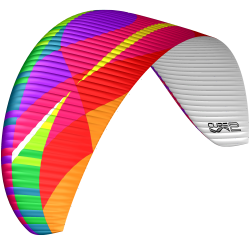 Alkaline
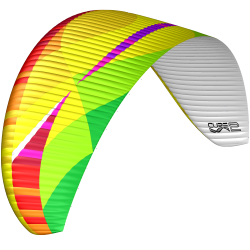 Halogen
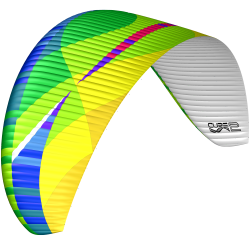 Enzyme